Indian Medical Visa Guide 2026: Avoid These 5 Costly Rejection Mistakes

Disclosure: Some links in this article are affiliate links. If you make a purchase through them, we earn a small commission at no extra cost to you.
You have chosen your world-class cardiac or ortho specialist. You have your surgical quote. Now comes the most critical step: securing your entry. Navigating the legalities of an Indian medical visa guide is essential to ensure you aren’t rejected at the boarding gate. India has strict rules about who can enter for medical treatment. If you are just starting your journey and need a broader overview of costs and hospitals, read our Medical Tourism Guide. However, if you have already chosen your doctor, this Indian medical visa guide will ensure you land without a hitch.
The e-Medical Visa (M-Visa) vs. Medical Attendant Visa (MX-Visa)
The e-Medical Visa is specifically for patients seeking specialized treatment in recognized Indian hospitals.
- Triple Entry: As of 2026, the e-visa allows for three entries within a 60-day window.
- Medical Attendant (MX): Up to two blood relatives can accompany the patient. Their MX-Visa is co-terminus with the patient’s stay.
Pro-Tip: The Axis Bank Payment Gateway
When using the government portal, international travelers often face “Transaction Failed” errors.
The Pro Fix: Always select the Axis Bank gateway during payment. You do not need an Axis account; it is simply the most robust processor for foreign Visa and Mastercard payments on the Indian government servers.
The Golden Rule: Tourist vs. Indian Medical Visa
One of the most frequent questions we address in this Indian medical visa guide is whether a standard Tourist Visa is sufficient for healthcare travel. The answer depends entirely on the nature of your treatment.
- YES, use a Tourist Visa if: You are visiting for an initial Consultation, a preventive Health Check-up, or a Minor Procedure. If you are only coming for minor dental work, read our Dental Tourism Guide to see if a Tourist Visa is sufficient for your specific treatment plan.
- NO, you MUST apply for an Indian Medical Visa if: You are undergoing Major Surgery (Cardiac, Orthopedic, IVF, or Transplants) or any procedure requiring In-Patient admission.
The Consequence: Under 2026 regulations, hospitals are legally mandated to report all international admissions to the FRRO (Foreigners Regional Registration Office). If you attempt to check in on a Tourist status for surgery, the facility will be legally barred from admitting you. Using this Indian medical visa guide ensures you stay compliant with Ministry of Home Affairs protocols.
The e-Medical Visa (M-Visa) for Patients
The e-Medical Visa (M-Visa) is the specific category for those seeking specialized treatment in recognized or JCI-accredited hospitals. Unlike a tourist entry, this Indian medical visa guide confirms that the M-Visa is a dedicated clinical authorization.
- Eligibility: International patients seeking neurosurgery, cardiac care, orthopedics, or organ transplants. (Note: Surrogacy is not permitted under this category).
- Validity: Strictly 60 Days from the date of your first arrival in India.
- Entries: As of 2026, it is a Triple Entry visa. This allows you to fly to India, travel for recuperation (perhaps a quick trip to Nepal or Sri Lanka), and return for follow-up checks without re-applying.
- Cost: Standard fee is $80 – $102 USD for most nationalities (USA/UK/Australia may incur higher reciprocity fees up to $140).
- Extension: If your recovery requires more than 60 days, you can apply for an extension of up to one year via the e-FRRO portal. You must provide a fresh medical certificate from your Indian hospital.
The e-Medical Attendant Visa (MX-Visa)
You don’t have to navigate your surgery alone. The e-Medical Attendant Visa (MX-Visa) is designed specifically for those supporting the patient.
- Who is it for? Blood relatives (Spouse, Children, Parents) or legal caregivers.
- The Limit: A maximum of 2 Attendants are permitted per patient.
- The Rule: The MX-Visa is co-terminus with the patient’s M-Visa. If the patient’s stay is extended or they leave the country, the attendant’s visa status changes accordingly.
- Requirement: Both attendants must use the same Medical Reference Number (found on the patient’s Invitation Letter) during their application.
The “Visa Invitation Letter” (VIL): Your Golden Ticket
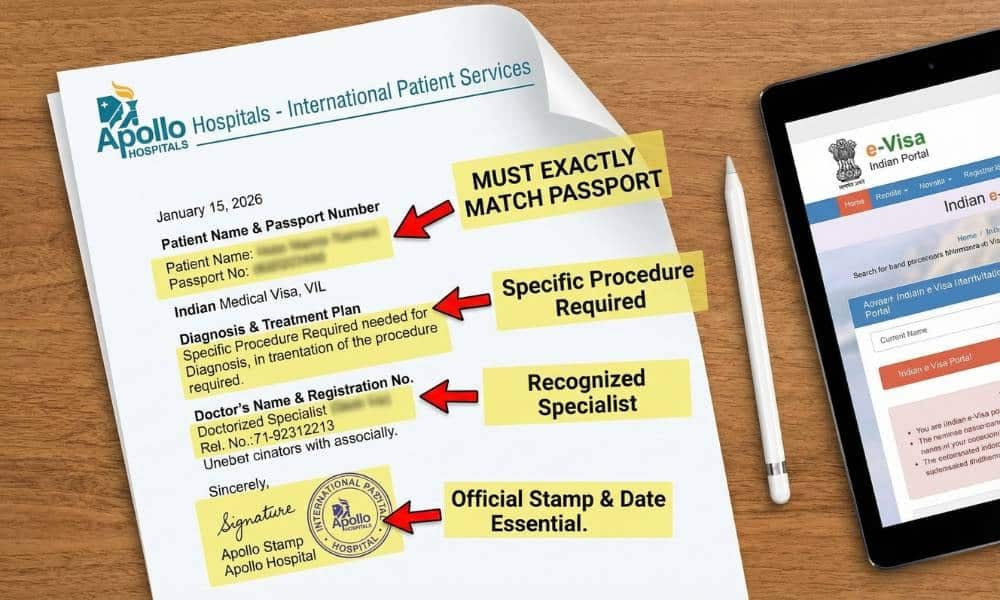
You cannot apply for an M-Visa without a valid Visa Invitation Letter (VIL). In 2026, this is more than just proof of a medical appointment—it is a digital authorization that the Indian government uses to pre-verify your treatment. This Indian medical visa guide highlights that without a system-generated letter, your e-Visa application will be automatically rejected.
What is it? An official, digital document issued by a registered Indian hospital through the government’s official Medical and Ayush Visa Portal. Once the hospital enters your details, the system generates a unique Medical Reference Number that you must enter into your e-Visa application.
It Must Contain:
- Medical Reference Number: A unique ID generated by the FRRO portal (Mandatory for 2026).
- Patient Details: Full Name, Nationality, and Passport Number (must match your passport exactly).
- Attendant Details: Names and Passport Numbers for your maximum of two caregivers.
- Surgical Plan: The specific procedure (e.g., “Robotic Heart Bypass”) and the duration of the hospital stay.
- Hospital Credentials: The hospital’s JCI or NABH accreditation number must be clearly visible.
How to get it:
- The Hard Way: Coordinating with hospital administrative desks via email. This often takes 4–5 business days and carries a high risk of “typo rejections” where a name is misspelled, forcing you to start the process over.
- The Easy Way: Use an authorized facilitator like My1Health. They are directly integrated with the hospital portals of Apollo, Medanta, and Fortis. They generate your VIL with the Medical Reference Number instantly once your doctor is confirmed, ensuring your Indian medical visa guide steps are followed perfectly.
Step-by-Step Application Process (e-Visa): The Two Ways
Following this Indian medical visa guide gives you two distinct paths. You can either navigate the official government infrastructure yourself or use a high-touch concierge service to eliminate the risk of a technical rejection.
Option 1: The “Concierge” Way (Recommended for Peace of Mind)
The official portal is notoriously unforgiving. In 2026, even a minor shadow on your digital photo or an improperly formatted PDF can trigger an automatic rejection.
Use iVisa if: You want an expert to manually review your documents, resize your photos to government specs (5×5 cm), and ensure your Indian medical visa guide requirements are met before submission.
- Cost: Government Fee + Service Fee (Approx $30-$50 extra).
- The Benefit: They accept all foreign credit cards/PayPal (which the government site often rejects) and offer 24/7 Chat Support.
- Special Offer: Get 20% off the service fee using our link below.

Option 2: The “Official” Government Portal (Cheapest)
If you choose to apply directly, this Indian medical visa guide recommends starting the process at least 14 days before your flight. While the site mentions 72 hours, 2026 processing times now frequently take 8–10 days due to enhanced vetting.
Step 1: Go to the Official Portal
- This Indian medical visa guide recommends using the official portal only if you have high-speed internet and perfectly scanned documents, as the session often times out during the payment phase.
- URL: indianvisaonline.gov.in
- Warning: Do not Google “Indian Visa.” You will find expensive private agencies that look like government sites. Look for the .gov.in domain.
Step 2: Fill the Application
- Start Your e-Visa Application Select “e-Medical Visa”. You will need to provide your personal details exactly as they appear in your passport’s bio-page. For the “Reference Name in India,” use the hospital name and contact details provided in your Invitation Letter.
Step 3: Upload Documents
- Photo: A clear, white-background photo (JPEG).
- Passport: Scanned bio-page (PDF).
- Letter: The Visa Invitation Letter(VIL) from the hospital (PDF).

Step 4: Pay & Wait
- Pay the fee using a Credit/Debit card.
- Pro Tip: When choosing a payment gateway, select “Axis Bank”. You do not need an Axis account to use it; it simply processes international credit cards (Visa/Mastercard) much better than the SBI gateway.
- Processing typically takes 24 to 72 hours.
Step 5: The Mandatory 2026 e-Arrival Card
- After receiving your Electronic Travel Authorization (ETA), you must fill out the e-Arrival Card (Digital Disembarkation Form) on the same portal up to 72 hours before landing. This replaces the old paper forms.
Step 6: Print Your ETA
- You must carry a physical printout of your “GRANTED” ETA to show at the immigration counter in Delhi, Mumbai, or your arrival city.
🩺 2026 Indian Medical Visa guide: Updated FAQs
📚 References & Official Links (Click to Expand)
1. The Only Official Visa Portal
- Indian Visa Online (Govt of India): Apply for e-Medical and e-Medical Attendant visas here.
- 🔗 Official Application Portal ↗
2. Visa Extensions (FRRO)
- e-FRRO Portal: For visa extensions and registration if you stay longer than 180 days.
- 🔗 Visit e-FRRO ↗
3. Guidelines
- Bureau of Immigration: FAQs on Medical Visas.
- 🔗 Read Official Guidelines ↗
Conclusion: Your Stress-Free Path to Healing
Don’t let a simple clerical error stand between you and your recovery. As this Indian medical visa guide has shown, success lies in the details—matching your passport exactly to your Invitation Letter and choosing the right visa category from day one.
By prioritizing your paperwork today, you ensure that your focus remains entirely on healing tomorrow. Get your system-generated Invitation Letter sorted, verify your documents, and you are just a few clicks away from a new lease on life.