The Great Living Chola Temples: Decoding India’s Granite Marvels

Disclosure: Some links in this article are affiliate links. If you make a purchase through them, we earn a small commission at no extra cost to you.
Exploring the Great Living Chola Temples is the most profound way to witness how ancient India successfully married spiritual devotion with impossible engineering. Imagine building a 216-foot skyscraper over 1,000 years ago without the aid of cranes, cement, or modern power tools. The Chola Empire didn’t just build shrines; they engineered “Granite Batteries” that have survived earthquakes and invasions for a millennium.
While the Taj Mahal is celebrated for its romantic symmetry, the Great Living Chola Temples are revered for their mastery of physics and structural integrity. In this guide, we decode the engineering secrets and spiritual power of the “Big Three”: Thanjavur, Gangaikonda Cholapuram, and Darasuram.
🪷 BharatDesha Quick Take
The Chola Dynasty: Architects of a Golden Age
Before we decode the stones, we must understand the kings. The Chola Empire (approx. 850 AD – 1250 AD) was one of the longest-ruling dynasties in world history. At its peak, the Chola Navy turned the Bay of Bengal into a “Chola Lake,” controlling trade routes and spreading Indian culture, mathematics, and architecture across Southeast Asia.
These temples weren’t just religious centers; they were the Economic Hubs of the empire. They housed the royal treasury, acted as schools for the arts, and managed massive irrigation projects. When you stand before a Chola Vimana, you are looking at the headquarters of a global superpower.
The Engineering Miracle: “No Cement”
How do these structures stand for 1,000 years? The answer lies in Seismic Engineering long before the term existed.
The Puzzle Technique (Dry-Masonry)
The Cholas used Interlocking Stone. There is no lime mortar or cement between the granite blocks. They are cut with such laser precision that they lock into each other like a jigsaw puzzle. The 200,000-ton structure is held together purely by Gravity and Balance.
The “Double-Wall” Ribcage
To support the massive weight of the Thanjavur temple, engineers invented a hollow, double-wall construction.
- The Outer Wall: Takes the external load.
- The Inner Wall: Supports the internal sanctum.
- The Gap: This hollow space allows the structure to “flex” during tremors, acting like a structural shock absorber.
The “Imperial Dravidian” Style: Your Cheat Sheet
If you want to spot a Chola temple among the thousands in South India, look for these two signatures:
The Vimana Dominance
In later Dravidian styles (like Madurai’s Meenakshi Temple), the Gopurams (Gateways) are the giants. In Chola architecture, the Vimana (the tower over the deity) is the tallest structure. It represents Mount Meru, the cosmic center of the universe.
The Vocabulary of Stone
- Kumbam: The massive capstone at the peak.
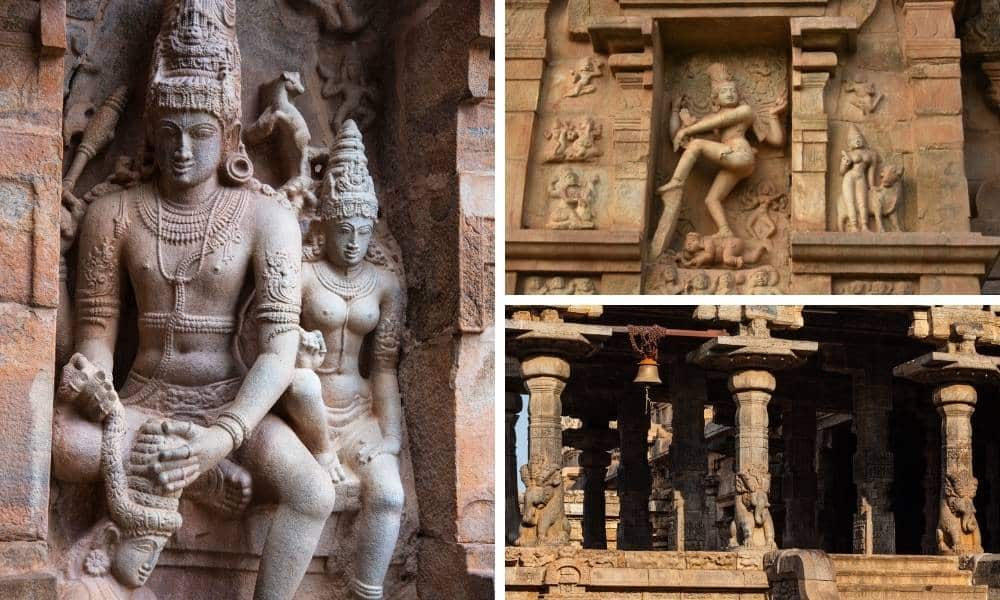
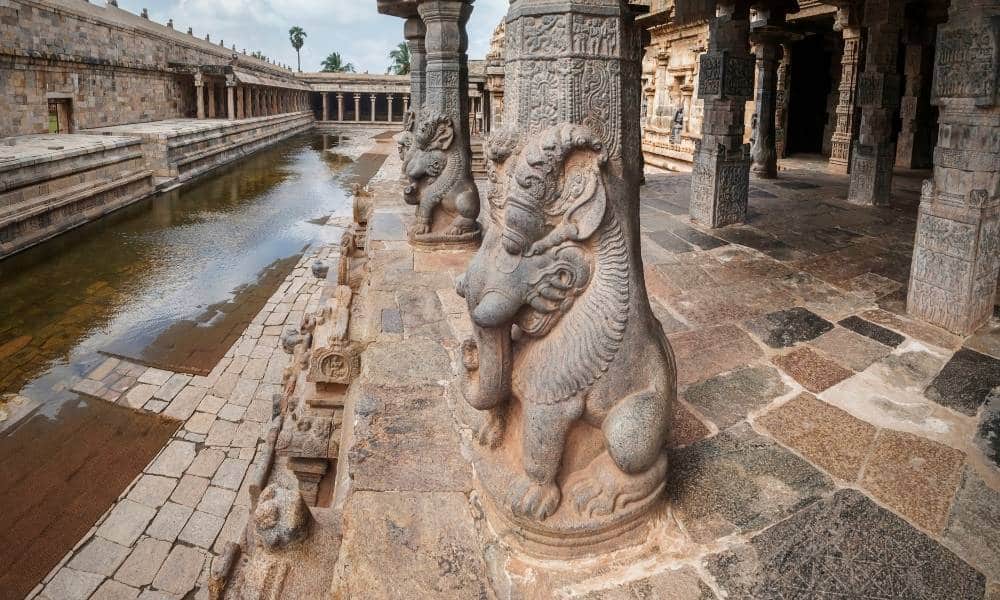
- Yali Pillars: Look at the base of the pillars to find the Yali—a mythical beast with the trunk of an elephant and the body of a lion, symbolizing the union of wisdom and power.
The “Big Three”: The Great Living Chola Temples
UNESCO recognizes these three sites collectively because they represent the “Living” evolution of a civilization. Unlike the ruins of Rome, these are active centers of worship where 1,000-year-old rituals continue today.

1. Brihadeeswarar Temple (Thanjavur): The Zenith of Power
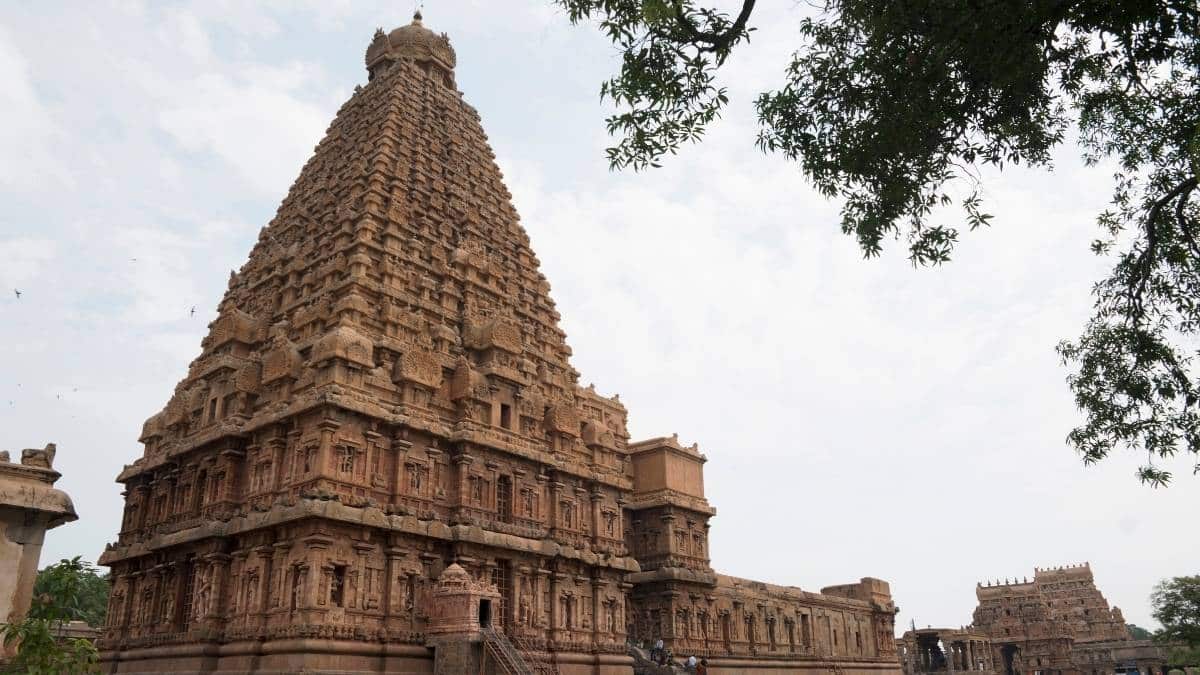
Known locally as Thanjai Periya Kovil (The Big Temple), this structure was completed in 1010 AD by Emperor Raja Raja Chola I. It wasn’t just a temple; it was a declaration of imperial sovereignty.
The History: A King’s Vision
Raja Raja I reportedly had a dream while in Sri Lanka that inspired him to build a temple of such scale that it would “touch the heavens.” It was built in just seven years, a timeframe that modern engineers find staggering given that the granite was quarried from over 60 kilometers away.
The Engineering Miracle: The Hollow Vimana
Most people assume the 216-foot tower is solid stone. It isn’t. The Vimana is actually hollow. It is built with two walls—an inner wall and an outer wall—with a narrow gap between them. This “Double Wall” construction allows the building to distribute the massive weight of the 80-ton capstone while remaining flexible enough to withstand earthquakes for over 1,000 years.
The Mathematics of Divinity

Interestingly, the structural stability of the Great Living Chola Temples is not merely a result of massive granite use; rather, it is a triumph of sacred geometry. A landmark study published on ResearchGate confirms the presence of the Golden Ratio (φ) in the temple’s axial alignment. This mathematical precision explains how the 216-foot Vimana remains perfectly balanced after a millennium of seismic activity.
The 80-Ton Mystery (The Kumbam)
Even with the Golden Ratio ensuring structural harmony, one question remains: How did the Cholas lift a single block of granite weighing 80 tons (80,000 kg) to the top of a 216-foot tower? Consequently, without modern cranes or pulleys, this feat remains one of the greatest unsolved mysteries of the ancient world.
- The Logistics: Instead of magic, historians point to a 6-km long inclined ramp that allowed elephants to drag the stone into place. Watch this breakdown of the “Kumbam” engineering to see the scale of this achievement:
If you are looking for guided tours to live the the three Great Living Chola Temples; there are a lot of options available from Trichy.
Recommended Watch: While diagrams help us visualize the proportions, the sheer scale of the engineering is best understood through the lens of modern historians. See the HistroryTV18 Video.
2. Gangaikonda Cholapuram: The Son’s Masterpiece
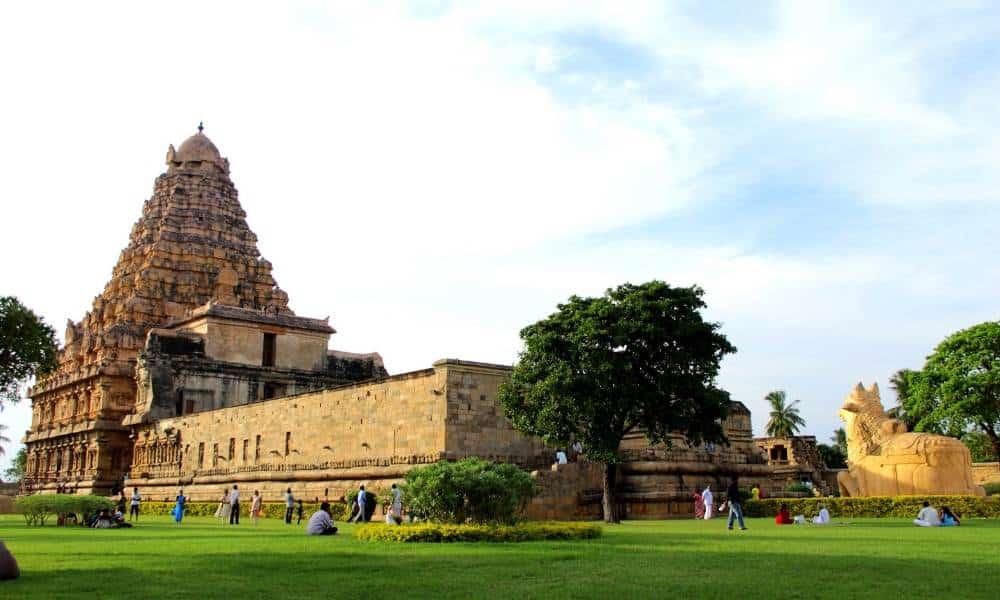
In 1035 AD, Rajendra Chola I (the son of Raja Raja) decided to build his own capital after his military campaign reached the banks of the Ganges in North India. He named the city Gangaikonda Cholapuram—”The City of the Chola who Conquered the Ganges.”
The History: Bringing the Holy Water South
To consecrate the temple, Rajendra Chola did not just bring gold; he brought holy water from the Ganga. He poured it into a massive man-made reservoir called the Chola Gangam (now known as Ponneri Lake), creating a “Liquid Pillar of Victory.”
The “Feminine” Architecture
While the Thanjavur temple is known for its sharp, straight, and rigid lines (Masculine energy), this temple is world-famous for its concave curves. The Vimana curves inward as it rises, giving it a softer, more rhythmic silhouette.
- The Sculpture: This temple houses one of the most beautiful sculptures in India—the Chandesura Anugraha Murti, depicting Lord Shiva blessing a devotee. The level of detail in the stone jewelry and facial expressions is so high it looks more like clay than granite.
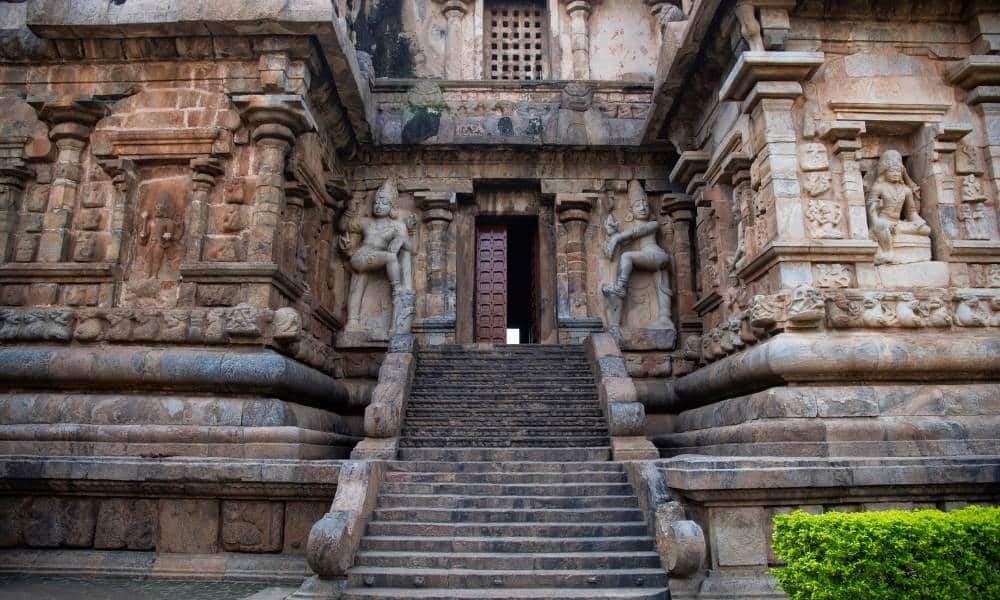
 Dwarpals stand guard at the entrance
- Gangaikonda Cholapuram Vimana
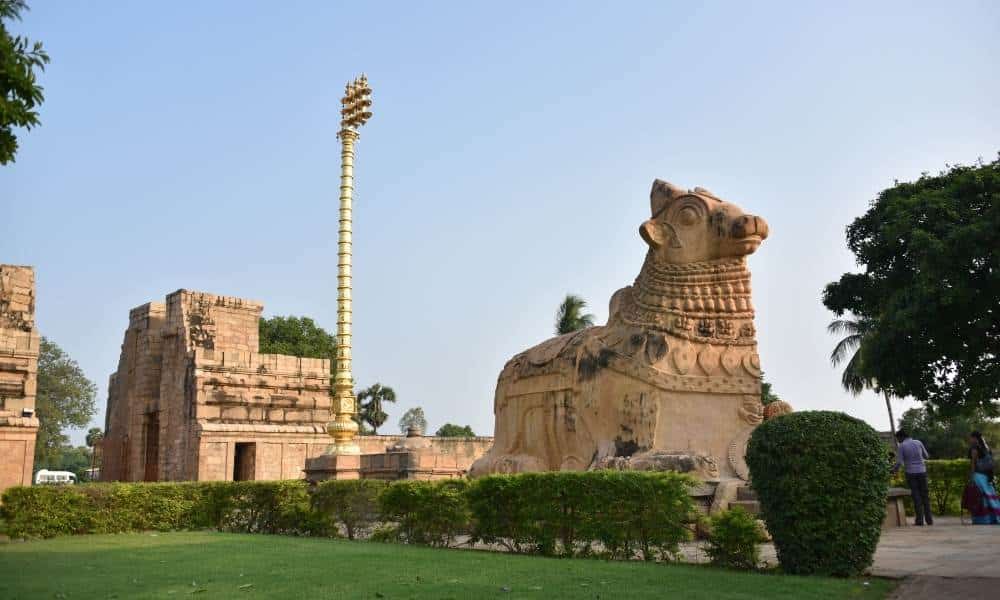
- Nandi
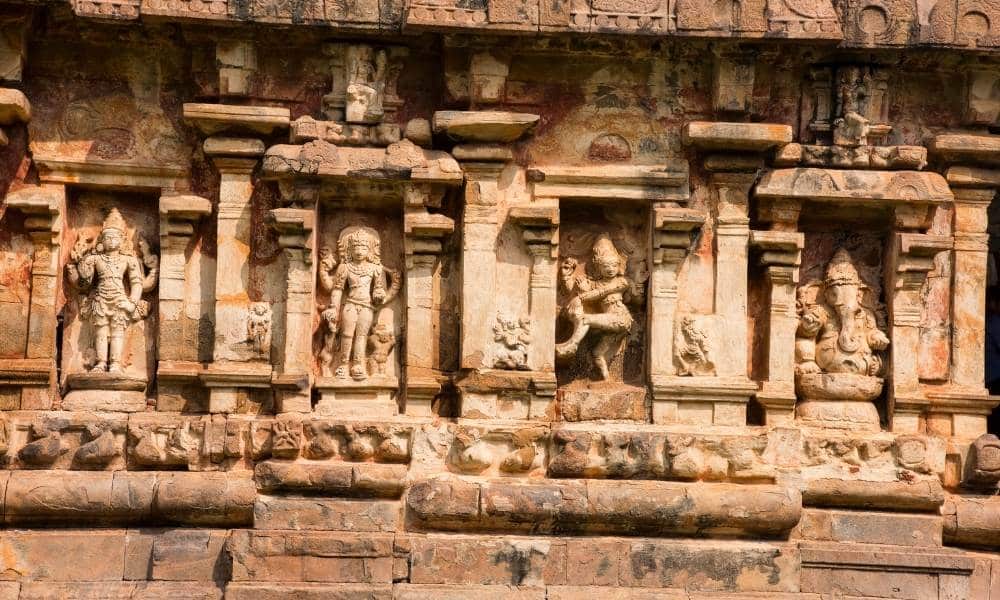
- Ganpati Bappa & Dieties
3. Airavatesvara Temple (Darasuram): The Sculptor’s Poetry
Built in the 12th Century by Raja Raja Chola II, this temple marks a shift in the empire’s focus. The scale became smaller, but the artistry became microscopic.
The History: The Legend of the White Elephant
The temple is named after Airavata, the white elephant of Lord Indra. Legend says Airavata, cursed with skin discoloration, prayed here and bathed in the sacred tank, regaining his pristine white color. To this day, the temple is considered a place of “Aesthetic and Physical Healing.”
The Chariot in Stone (Nitya-Vinoda)
The Agra-Mandapa (front hall) is a visual miracle. It is designed to look like a celestial chariot being pulled by stone horses and elephants. The wheels of the chariot are carved with such precision that they contain “Miniature Carvings” within the spokes that tell the life stories of 63 Saivite saints.
The Physics of the Musical Steps
Located at the entrance to the Balipeetham (offering platform) are seven stone steps.
- How it works: When you tap these steps, they vibrate at specific frequencies that correspond to the Sapthaswara (the seven notes of the Indian scale).
- The Secret: Chola craftsmen used different densities of granite and varied the thickness of the hollowed-out stone underneath each step to create “Acoustic Resonance.” It is a 1,000-year-old experiment in Structural Lithophones.
- Yali Pillars
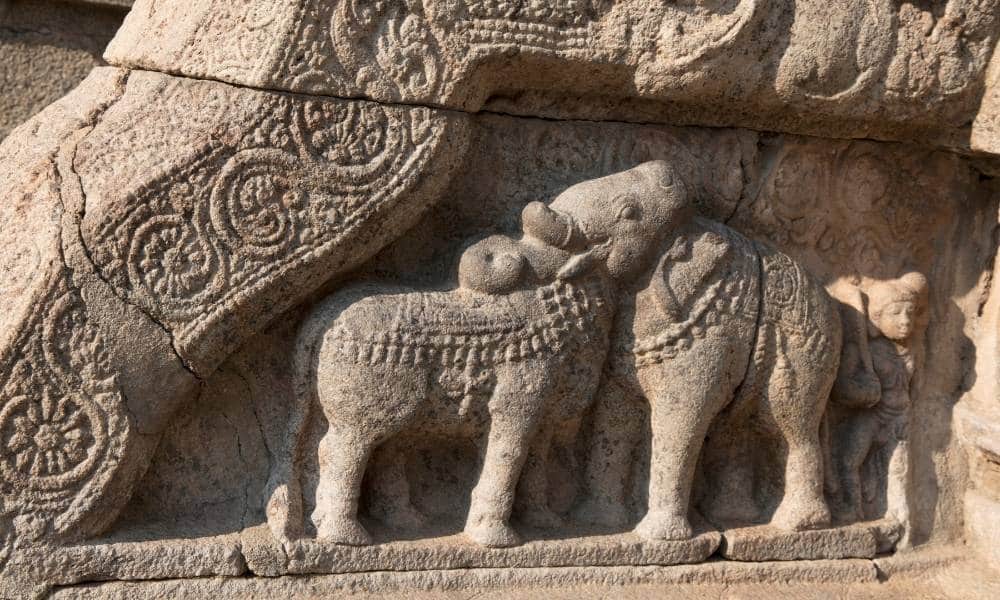
- Bull & Elephant Mashup
- Stone Chariot Mandapa Wheels
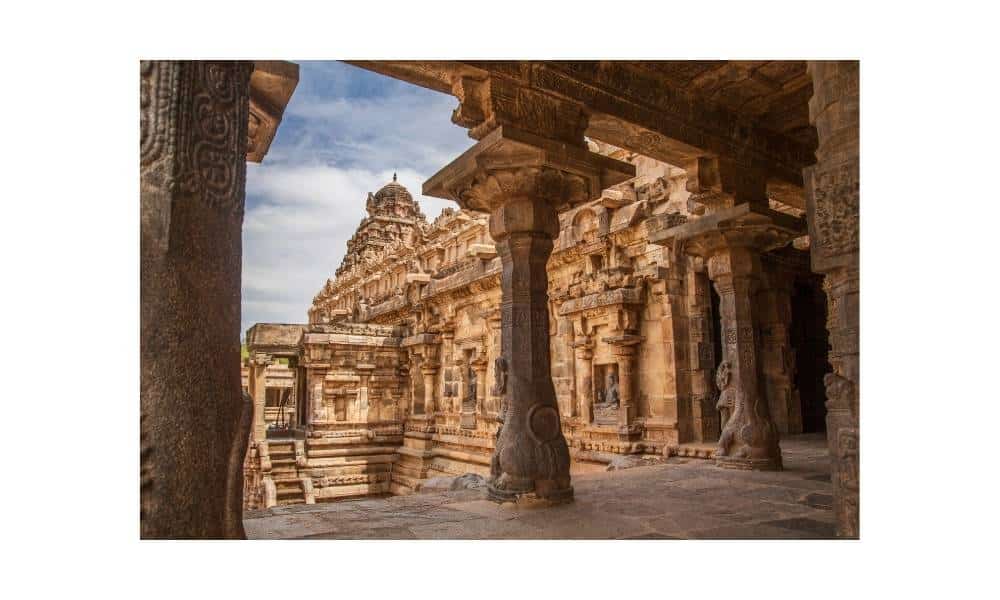
- Darasuram Airavatesvara Temple
- Darasuram Airavatesvara Temple Shikhara & Pillars


Why These Temples are “Living”
The UNESCO title “Great Living Chola Temples“ is very specific. Unlike the ruins of Hampi or the Pyramids of Egypt, these temples are active centers of worship. The rituals, the chanting, and the temple festivals have continued uninterrupted for 1,000 years. When you walk through these corridors, you aren’t just looking at history; you are participating in a continuous thread of Sanatan civilization.
The Sanatan Science: Why Granite?
Why did the Cholas struggle with Granite—one of the hardest substances on Earth—when sandstone was easier to carve?
Piezoelectric Energy Accumulation
Granite has a high Quartz content. When millions of tons of stone pressure are applied to quartz, it generates a subtle electrical charge—a phenomenon called the Piezoelectric Effect. The Vimana acts as an antenna, funneling this vibrational energy into the Garbhagriha (Sanctum).
Acoustic Resonance
The Cholas manipulated stone density to create “Lithophones.” At Darasuram, the steps were hollowed out to specific depths to create resonance at exact musical frequencies. Tapping the stone isn’t just making a sound; you are triggering the Natural Frequency of the rock itself.
The Heritage Drives: Reaching the Chola Heartland
In 2026, the journey to the Kaveri Delta is as much a part of the pilgrimage as the temples themselves. Whether you are driving from the tech-hub of Bangalore or the coastal capital of Chennai, the transition from urban sprawl to the lush, paddy-field “Glory” of the Chola heartland is profound.
The Bangalore to Thanjavur Drive Route (approx. 420 km)
For those embarking on a Bangalore to Thanjavur road trip, the most efficient route is via Salem and Namakkal.
- The Experience: You’ll start on the high-speed NH44 before transitioning to the scenic state highways near Musiri.
- 2026 Tip: The newly completed Namakkal-Trichy bypass has shaved off nearly an hour of traffic. Plan for a 7–8 hour drive. Stop for a traditional “Banana Leaf” lunch at Namakkal to fuel up before hitting the final stretch along the banks of the Kaveri River.
The Chennai to Thanjavur “Scenic” Route (approx. 340 km)
The drive from Chennai offers two distinct vibes: the speed of the GST Road (NH38) or the stunning “Glory” of the East Coast Road (ECR).
- The ECR Route: We highly recommend taking the ECR via Pondicherry and Chidambaram. While it takes longer (approx. 7–8 hours), it allows you to see the Nataraja Temple in Chidambaram—a vital precursor to the Chola architectural style.
- The GST Route: If time is of the essence, the GST road is the “Grit” option. It is a 6-lane powerhouse that can get you to Thanjavur in under 6 hours. In 2026, the Vande Bharat Express from Chennai Egmore to Thanjavur is also a fantastic alternative for those who prefer the rails over the road.
Frequently Asked Questions
Conclusion: Stones That Speak
The Great Living Chola Temples prove that ancient India was a marriage of profound spirituality and advanced mathematics. To walk through these granite corridors is to realize that the Cholas didn’t just build temples; they built a legacy in stone that time cannot erase. Consequently, whether you are admiring the 80-ton capstone of Thanjavur or the musical steps of Darasuram, you are witnessing a pinnacle of human achievement.
Trichy: The Gateway to the Chola Heartland
While many travelers from Bangalore, Chennai, Mysore, and Coimbatore enjoy a scenic Tanjavur road trip by making Trichy their base, the city is also a vital gateway for those coming from further afield. Tiruchirappalli International Airport (TRZ) is very well-connected with all major airports across India, making it the perfect entry point for global travelers and pan India travelers alike. Consequently, Trichy is the ideal place to establish a base; from here, you can easily access all three Great Living Chola Temples in a single, efficient loop.
There are also many guided tours available from Trichy to see all the three Great Living Chola Temples.
Editor’s Note: The Heritage Toolkit
Ready to see these granite marvels in person? We have curated the resources you need to turn a sightseeing trip into a deep cultural immersion.
- The Big Picture: If you are planning your first trip to India, start with our Ultimate Guide to Planning Your First Trip to India for logistics, 2026 visa updates, and cultural etiquette.
- The Route: Whether you are embarking on a Tanjavur road trip from Bangalore, Chennai, or Coimbatore, or flying directly into Tiruchirappalli International Airport (TRZ), Trichy serves as the perfect base. Our vetted (Coming Soon) 9-Day Tamil Nadu Heritage Itinerary seamlessly connects the three Great Living Chola Temples with the artistic hubs of Kumbakonam and Chettinad, regardless of your starting point.
- The Gear: Navigating the Kaveri delta requires a prepared vehicle. Check our India Road Trip Packing List to ensure your dashcam is ready to capture the scenic highways and your tire inflator is at hand.