
Ram Mandir Ayodhya Guide: The 500-Year Journey to Glory (2026)

Disclosure: Some links in this article are affiliate links. If you make a purchase through them, we earn a small commission at no extra cost to you.
A Note on Significance
This is not merely a travel guide; it is a chronicle of a civilization’s rebirth. On January 22, 2024, the world witnessed the Pran Pratishtha (consecration), where the divine soul entered the deity. On November 25, 2025, the journey reached its absolute structural and spiritual conclusion with the establishment of the Dhwaj (The Divine Standard) atop the completed 161-foot Shikhar.
“अवधपुरी मम पुरी सुहावनि। उत्तर दिसि बह सरजू पावनि॥” Awadhpuri mam puri suhavani, Uttar dishi bah sarju pavani. (Ayodhya is my beloved city, beautiful beyond words, where the holy Saryu flows to the North.) — Goswami Tulsidas, Ramcharitmanas
Ayodhya is not merely a city on a map. In the Atharvaveda, it is described as a city built by the Gods, a place of eternal unassailability (A-yodhya = One which cannot be conquered).
For centuries, this city carried the weight of a historical wound. Today, that wound is healed. This Ram Mandir Ayodhya guide is curated for the devotee and the seeker who wish to understand the History, the Architecture, and the Divine Experience of the Shri Ram Janmabhoomi Mandir.
📿 BharatDesha Quick Take
The 500-Year Tapasya: The Struggle for Truth
The temple you see today does not merely stand on sandstone; it stands on a foundation of five centuries of unshakable faith and immense sacrifice.
- 1528 (The Darkness): The original temple marking the birthplace of Lord Ram was destroyed. While a new structure was raised over it, the flame of devotion never flickered; Hindus continued to worship the sacred ground from the outside for centuries.
- The Years of Waiting: For 490 years, the reclamation of the Janmabhoomi saw 76 distinct battles. This flame was kept alive by a lineage of saints, kings, and common citizens who refused to let the memory of the site fade.
- 1992 (The Karseva): The movement reached a turning point as the sacrifices of thousands of Karsevaks paved the ultimate path for the land’s reclamation.
- 2019 (The Justice): In a historic 1,045-page verdict, the Supreme Court of India handed the land back to the deity, Ram Lalla Virajman, recognizing the site’s profound historical and spiritual significance.
- January 22, 2024 (The Pran Pratishtha): The 500-year Vanvas (exile) officially ended. The idol of Ram Lalla was consecrated in the presence of the nation’s leadership, marking the return of the King to his rightful palace.
- November 25, 2025 (The Completion): The spiritual “Axis Mundi” was finalized. With the completion of the main Shikhar, the Ram Kul Dhwaj was established at the highest point, signaling to the world that the soul of Bharat has found its home.

The Result: A 500-year Vanvas (exile) ended. Ram Lalla returned to his rightful palace.
Watch The History of Ram Temple In Ayodhya
Follow ShashvatResearch for more such insightful videos.
The Architecture: A Symphony in Pink Sandstone
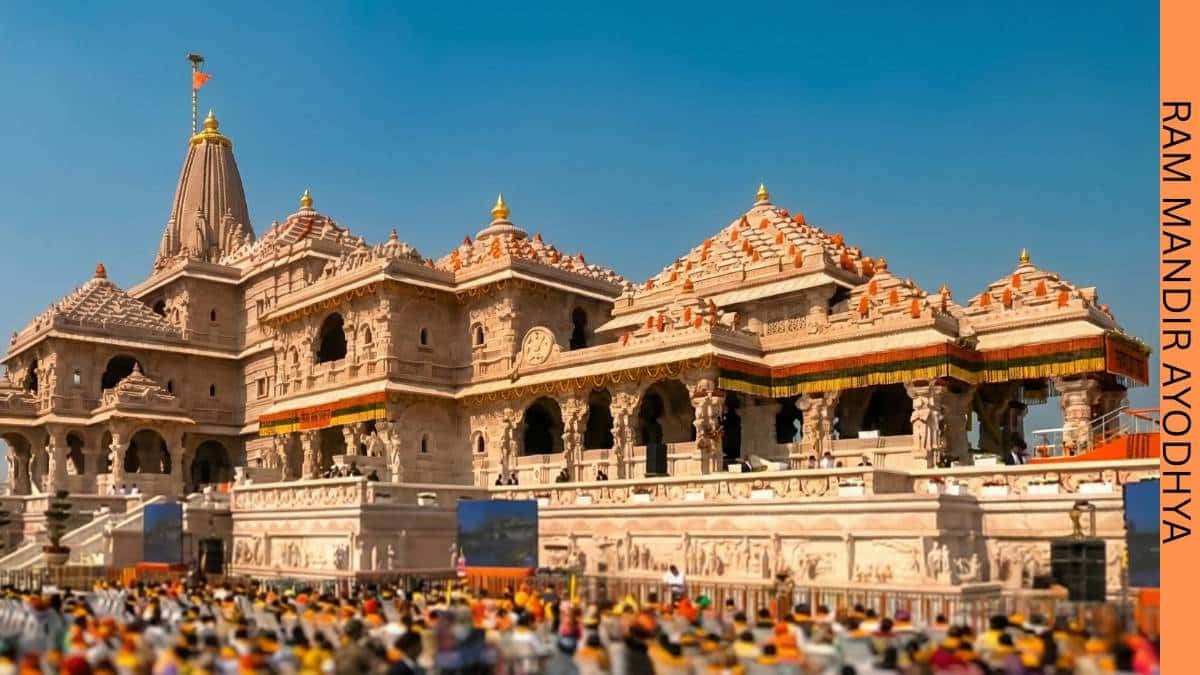
The Shri Ram Janmabhoomi Mandir is a masterpiece of the Nagara Style of temple architecture, meticulously engineered to endure for over 1,000 years without the need for modern structural reinforcement.

- No Iron, No Steel: The temple is constructed entirely of Bansi Paharpur Pink Sandstone sourced from Rajasthan. To ensure longevity, the blocks are interlocked using high-purity copper plates; since iron rusts and expands, stone and copper were chosen for their timeless endurance.
- The Surya Tilak (Science Meets Faith): In a feat of astronomical precision, the temple features a unique optical system designed by CBRI Roorkee and IIA Bengaluru. Every Ram Navami at exactly 12:00 PM, a series of mirrors and lenses directs sunlight into the sanctum to form a brilliant 58mm “Tilak” on the forehead of the deity for approximately four minutes.
The Deity: Ram Lalla (The Child King)
Standing within the Garbhagriha (Sanctum Sanctorum) is the idol that has captivated the global consciousness with its divine aura.
- The Form: The deity is depicted as Ram Lalla—the five-year-old child form of Lord Ram. He stands gracefully with a golden bow and arrow, his expression radiating a blend of majesty and childlike innocence.
- The Stone: Sculpted from Krishna Shila (Black Granite) unearthed in Karnataka, the idol is physically resistant to the water and milk used during daily Abhishek (ritual bathing).
- The Living Eyes: Renowned sculptor Arun Yogiraj carved the eyes with such precision that they appear “alive.” Devotees frequently observe that the expression seems to shift depending on the angle—reflecting sternness to some and a gentle smile to others.
“नीलाम्बुज श्यामल कोमलांगम, सीता समारोपित वाम भागम…” Neelambuj shyamal komalangam… (Salutations to Vishnu, whose body is as beautiful and soft as a blue lotus…)
The Symbolism: The Ram Kul Dhwaj
Fluttering high atop the 161-foot Shikhar is the saffron standard known as the Dhwaj. This is not a mere banner; it is the spiritual identity of Bharat itself.
- The Unifying Force: Lord Ram is the thread that binds India. From Ayodhya in the North to Rameshwaram in the South, his journey defined the cultural geography of this nation millennia before maps were drawn.
- The Ideal of Ram Rajya: The flag represents the ultimate Indian ideal of governance—where the ruler exists solely for the welfare of the last person in the line (Antyodaya). It is a symbol of Justice (Nyay) and Truth (Satya).
- The Insignia The Dhwaj bears a powerful composite emblem. The Kovidara Tree (Bauhinia variegata) The ancient royal insignia of Ayodhya and The Rising Sun with Om. Lord Ram belongs to the Suryavansh (Solar Dynasty). The Sun represents brilliance, while the sacred Om at its center signifies the cosmic reality.
Seeing the Dhwaj flutter against the blue sky is considered a Darshan in itself. It proclaims to the world: “The Soul of Bharat has found its home.”

Dhwaj vs. Zhenda (Flag)
The western world sees no difference between a Dhwaj and a Zhenda (Flag).
While often used interchangeably, there is a profound distinction between the two. A Zhenda (or Flag) is a secular banner signifying a celebratory victory. In contrast, a Dhwaj is a sacred standard that signals the Authority and Living Presence of the Deity. It serves as the Axis Mundi, a spiritual bridge connecting the earthly Garbhagriha to the cosmic heavens.
The Mandir Complex: A 70-Acre Spiritual City
The main temple occupies only 2.7 acres. The rest of the 70-acre complex is a masterclass in planning, designed to reflect Ram Rajya (an inclusive kingdom).
- The Parkota (The Great Wall) The main temple is surrounded by a massive rectangular perimeter wall (Parkota) running 732 meters long. This is not just security; it is a “Parikrama” (circumambulation) path for devotees.
- The 7 Temples of Social Harmony In a profound message of unity (Samajik Samrasata), the complex features distinct temples dedicated to the sages and figures who shaped Ram’s life, crossing all caste and class boundaries:
- Maharishi Valmiki: The author of the Ramayana.
- Maharishi Vashishtha & Vishwamitra: The Guru and the Guide.
- Mata Shabari & Nishad Raj: The tribal devotee and the boatman king, symbolizing Ram’s love for the marginalized.
- Devi Ahilya & Agastya: Representing redemption and wisdom.
- Kuber Tila & Jatayu
- The Shiva Temple: On the southwestern part of the complex lies the ancient Kuber Tila, where a Shiva temple has been restored. Ram always worshipped Shiva before any major undertaking.
- The Jatayu Statue: A colossal bronze statue of the vulture king Jatayu stands guard, symbolizing the ultimate sacrifice for the protection of women.

The Yatra Guide: How to Have Darshan

- The Rule of Hanuman Garhi Tradition dictates that you must visit Hanuman Garhi first. You must take the permission of the Kotwal (Guardian) before visiting his Master.
- Darshan Rules
- General Entry: FREE. No booking needed. Queue time is 1-2 hours.
- Sugam Darshan (Fast Track): Free but requires online booking. Slots open at midnight, 15 days in advance.
- Official Site: srjbtkshetra.org
- Aarti: Requires a pre-booked pass.
- Scam Alert: Do NOT pay anyone for tickets. Touts sell fake “VIP Passes.” The Trust does not sell paid tickets.
- Tech Ban: Strictly NO phones, smartwatches, or bags allowed inside. Deposit them in the free lockers before you join the line to avoid being sent back.
Beyond the Temple: Saryu Aarti & Deepotsav
Ayodhya’s spiritual energy extends far beyond the temple walls to the banks of the sacred Saryu river, which is believed to be a witness to the entire lifespan of Lord Ram.
- The Saryu Aarti: While Varanasi’s Aarti is famous for its “organized chaos,” the ritual at Ram Ki Paidi offers a meditative and melodic counterpoint.
- The Vibe: The ceremony is characterized by synchronized chants and rhythmic bell-ringing that feels more intimate and accessible than the large-scale spectacles in other holy cities.
- Timing: The Aarti begins at sunset, typically between 6:00 PM and 6:30 PM. For the best experience, arrive 20 minutes early to secure a spot on the steps overlooking the water.
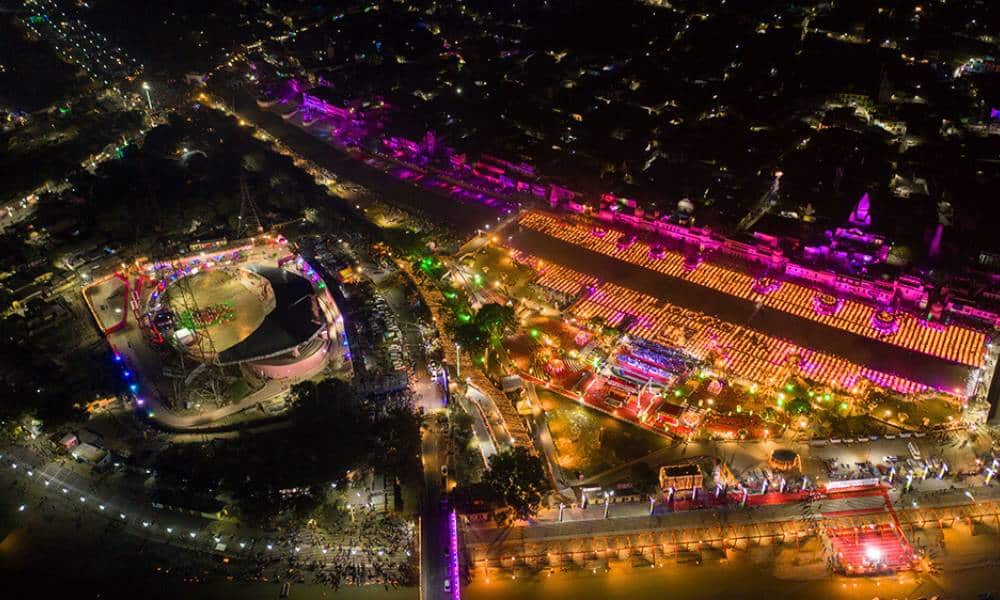
- Deepotsav (The Festival of Lights): If your journey falls during Diwali (October/November), you will witness Ayodhya’s transformation into a “City of Gold.”
- The Record: In 2024, Ayodhya secured its place in the Guinness World Records by lighting over 2.5 million earthen lamps (Diyas) across 51 ghats simultaneously, a tradition that has become the world’s largest display of oil lamps.


Updated 2026 Logistics
Where to Stay (Book Early!)
Luxury (Modern Comfort)

Park Inn by Radisson
Reliable 4-star modern comfort near the highway. Ideal for families.
Experience (Tent City)

Praveg Tent City
Luxury glamping near the Saryu River. Cultural programs included. Experience it.
Budget StAY (Clean & Simple)

Ramayana Hotel
Clean, close to the temple, and distinctively designed. Value for money.
Search all other hotel options in Ayodhya
How to Reach Ayodhya
By Air: The Maharishi Valmiki International Airport (AYJ) is now fully operational, with direct flights connecting Ayodhya to Delhi, Mumbai, Bengaluru, and Ahmedabad.
By Train: Ayodhya Dham Junction is a world-class station inspired by the temple’s own Nagara architecture.
- From Delhi (Anand Vihar): Take the 22426/22425 Ayodhya Dham Vande Bharat Express, which completes the journey in approximately 8 hours.
- From Lucknow: The 22349/22350 Patna-Lucknow Vande Bharat makes a strategic stop at Ayodhya Dham.
By Road: Access has been revolutionized by the new expressway network.
- From Lucknow: 2.5 hours via the NH27.
- From Varanasi: 4.5 hours via the newly upgraded Purvanchal Expressway link.
- Navigating the City: Within Ayodhya, use the three newly developed theme-based roads: Ram Path (the main arterial road), Bhakti Path, and Janmabhoomi Path for direct temple access.
The Sacred Library: Books for the Seeker
*As an Amazon Associate, BharatDesha earns from qualifying purchases at no extra cost to you.
The Bhakti Playlist: Immerse Yourself
Before you step onto the Bhakti Path, let these sounds prepare your heart for the experience. Close your eyes, listen, and visualize the gentle flow of the Saryu.
Ram Mandir Ayodhya: Frequently Asked Questions
📚 References & Official Links (Click to Expand)
1. Official Temple Trust
- Shri Ram Janmabhoomi Teerth Kshetra: The official body for construction and administration. Use this for Sugam Darshan booking.
- 🔗 Official Website ↗
2. Architectural & Engineering Facts
- L&T Construction (Case Study): Detailed engineering report on the “Zero Steel” construction and 1,000-year lifespan.
- 🔗 Read Engineering Report ↗
- CBRI Roorkee: The scientific institute that designed the structural stability.
- 🔗 Institute Website ↗
3. The Verdict (Full Judgment)
- Supreme Court Observer (PDF): Fast-loading reliable copy of the historic 1,045-page verdict.
- 🔗 Download PDF ↗
- Indian Kanoon (Text): Mobile-friendly text version.
- 🔗 Read Online ↗
Photo Credits & Acknowledgements
This guide would not be possible without the stunning visual archives from the official Shree Ram Janmbhoomi Theerth Kshetra and Uttar Pradesh Tourism. Selected images, and certain temple interiors, are courtesy of their public portals (uptourism.gov.in).
Conclusion: A Promise Kept
The Shri Ram Janmabhoomi Mandir is far more than a marvel of pink sandstone and ancient engineering. It is the living testament of a civilization that waited five centuries to keep a promise to its King. In the heart of Ayodhya, the “unconquerable city,” history has finally come full circle.
When you stand before the divine innocence of Ram Lalla, you are not just witnessing an idol; you are witnessing the restoration of a nation’s pride and the ultimate victory of Dharma. Whether you come as a devotee, a historian, or a seeker, Ayodhya offers a rare glimpse into a spirit that refuses to be forgotten.
Jai Shree Ram
Next Step: Complete the Moksha Triangle
Ayodhya is a profound beginning, but it is only one vertex in a sacred geometry. To truly experience the spiritual pulse of Bharat, we recommend completing the Moksha Triangle and diving into the roots of the tradition.
- Varanasi: The 2026 Travel & Culture Guide –> Journey to the “City of Light” to explore the 84 ghats, the eternal fires of Manikarnika, and the ancient silk-weaving traditions of Kashi.
- Prayagraj: The Sangam City & Beyond –> Discover the spiritual power of the Triveni Sangam, where the three sacred rivers meet, and explore the hidden history of one of India’s oldest living cities.
- (Coming Soon) The 7-Day Moksha Triangle Itinerary –> A master blueprint designed for seekers, covering the logistics, transport, and 2026 timing for a seamless journey through Ayodhya, Varanasi, and Prayagraj.
- What is Sanatan Dharma? Understanding the Eternal Way –> Go beyond the rituals. Explore the foundational philosophy of the “Eternal Way” that has guided the Indian subcontinent for millennia.


