

Shri Samartha Ramdas Swami: The Spiritual Architect of Hindavi Swarajya

Disclosure: Some links in this article are affiliate links. If you make a purchase through them, we earn a small commission at no extra cost to you.
Samartha Ramdas Swami emerged as a transformative force in mid-17th century Maharashtra, a period defined by social despair and the dominance of Mughal invaders. Far from being a saint confined merely to the walls of a temple, Samartha Ramdas Swami was a philosopher, a social reformer, and a strategic guide who fundamentally reshaped the spiritual and political landscape of India. By blending deep internal devotion with external social action, he provided the “spiritual spine” that would eventually support the rise of Hindavi Swarajya.
The Origin of “Samartha”
While many know him as Ramdas, the title “Samartha” (The Capable/Powerful One) has a profound origin. Traditionally, this title was an attribute of Lord Rama, the ultimate protector.
In the heart of the Ramdasi tradition, this strength is captured in these iconic lines:
समर्थाचिया सेवका वक्र पाहे । असा सर्व भूमंडळी कोण आहे ॥ जयाची लीला वर्णिली लोक तिन्ही । नुपेक्षी कदा रामदासाभिमानी ॥ जय जय रघुवीर समर्थ ।
The Meaning: “Who in this entire world dares to look with a crooked eye at the servant of the Almighty? The One whose glories are sung across the three worlds will never neglect those who walk His path.”
Because Ramdas Swami became so “Rama-conscious” (Ram-may) and his social work was so impactful, the people of Maharashtra recognized that the “Samartha” (the Divine Power) was acting through him. He didn’t just worship power; he became a conduit for it, eventually earning the title as a reflection of his own spiritual authority.
Early Life: The Boy Who Worried for the World
Samartha Ramdas Swami was born at the stroke of noon on Ram Navami in 1608, the same hour and day as Lord Rama himself. Born as Narayan in the village of Jamb to Suryajipant and Ranubai, his lineage was one of devoted Sun-worshippers (Surya-upasakas). This heritage of solar energy and discipline would later manifest in his lifelong advocacy for the Surya Namaskar.
The Loft Incident: A Vision Beyond Childhood
While other children were occupied with play, Narayan was often found in silent contemplation.
The Loft Incident: His mother once found him sitting in a trance-like state in the house loft. When she asked what he was doing, the young boy replied with a gravity that transcended his years: “Mother, I am worrying about the state of the universe” (“चिंता करितो विश्वाची”).
At a time when the socio-political fabric of Bharat was being torn by invasions, this wasn’t just a child’s imagination—it was the early stirrings of a national mission.
The Call of “Savdhan”: The Ultimate Alert
The most famous turning point in his life occurred at age 12. As he stood on the wedding altar, separated from his bride by the Antarpat (sacred cloth), the priests chanted the final Mangalashtaka, ending with the word “Savdhan!” (Be Alert!).
To the crowd, it was a ritual signal. To Narayan, it was a spiritual alarm clock.
- The Realization: He realized that if he took that one step forward into a mundane life, the “worries of the universe” he had felt in the loft would remain unaddressed.
- The Flight: He didn’t just run away from a wedding; he ran towards a destiny. He crossed the river and disappeared into the forests, eventually reaching Takli, near Nashik, to begin 12 years of rigorous physical and spiritual preparation.
A short thoughtful video by Shashvat Research on Samartha Guru Ramdas Swami
12 Years of Tapasya: Building Physical & Mental Fortitude (1620–1632)
Immediately after fleeing the marriage altar, Samartha Ramdas Swami dedicated twelve years to intense preparation at Takli, near Nashik. This wasn’t just a spiritual retreat; it was a rigorous training of mind and body.
- The Godavari Sadhana: He spent his mornings standing waist-deep in the Godavari River, completing a 13-crore chant (130 million) of the Rama Nama over twelve years.
- Physical Pillar: He performed 1,200 Surya Namaskars daily, teaching that physical strength is a non-negotiable prerequisite for spiritual and national service.
- Intellectual Mastery: During this time, he mastered the Vedas, Upanishads, and the Bhagavad Gita, even penning his own version of the Ramayana (the Ramayana-Sar).
12 Years of Bharat Bhraman: The National Diagnostic (1632–1644)
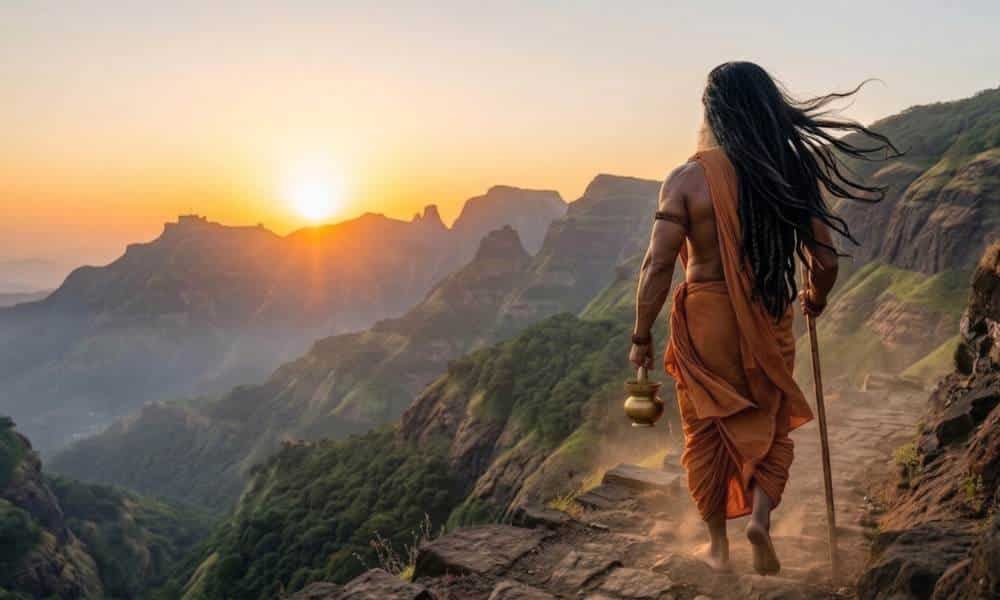
Having attained self-realization by age 24, Samartha Ramdas Swami spent the next twelve years walking the length and breadth of Bharat. This pilgrimage transformed his personal enlightenment into a national mission. He didn’t just see landscapes; he saw a “nation without a कणा (spine).”
- The Observation of Decay: He witnessed destroyed temples, suppressed traditions, and a society paralyzed by fear.
- From Devotion to Organization: He realized that individual “room-based” devotion was insufficient. For Bharat to survive, it needed a collective awakening—a fusion of spiritual wisdom and tactical organization.
A Social Reformer and Progressive Thinker
The Literary Legacy: From Mind to Metaphysics
Samartha Ramdas Swami was a prolific author whose writings were designed to be “functional.” He didn’t write for art’s sake; he wrote to build a resilient society.
- The Dasbodh (The Manual for Life): Composed in the secluded cave of Shivthar Ghal, this 20-chapter masterpiece is structured as a dialogue between a Guru and a disciple. Unlike other Bhakti texts that focus solely on the afterlife, the Dasbodh is a guide for Practical Management. He famously taught that spiritual growth is hollow without a well-managed material life:“प्रपंच करावा नेटका । मग साधावे परमार्थ विवेका ॥” (Prapancha karava netka | Mag sadhave paramarth viveka) Translation: First, manage your worldly duties excellently, then pursue spiritual wisdom with discernment.
- Manache Shlok (Verses for the Mind): While the Dasbodh is an advanced course in leadership, the Manache Shlok (205 verses) is the daily “Mental Gym” for the common man. It focuses on Internal EQ, teaching the mind to stay anchored amidst the chaos of the external world.
- Stotras and Aratis: It is a little-known fact that the iconic Ganpati Arati (“Sukhkarta Dukhharta”) and the Maruti Stotra were composed by him. These were tools for Cultural Cohesion, giving a fragmented society a common rhythm and a shared voice during gatherings.
The Ram Navami Movement: Awakening through Celebration
Centuries before modern leaders used festivals for social mobilization, Samartha Ramdas Swami established the public celebration of Ram Navami.
- Lok Sangrah (Community Organization): He used these festivals as a strategy for “Lok Sangrah”—gathering people from different castes and social strata under one banner.
- The Blueprint for the Future: This movement served as the spiritual precursor to the public Ganeshotsav started by Lokmanya Tilak. By celebrating the birth of the “Warrior Prince” (Lord Rama), he subtly prepared the masses for the idea of Hindavi Swarajya (Self-Rule).
A Pioneer of Empowerment
At a time when the socio-political climate was incredibly restrictive for women, Samartha Ramdas Swami was a radical advocate for gender equality.
- The Defiant Logic: When orthodox critics questioned the authority of these women, he famously retorted that since every man is born of a woman, anyone who fails to see their divinity and capability is unworthy of being called a “man.” For him, Dharma was a path open to every soul, regardless of gender.
- Institutional Leadership: He didn’t just allow women to listen to discourses; he appointed female disciples to head various mathas (monasteries). This was an unprecedented move for the 17th century.
The Spiritual Backbone of the Maratha Empire
The relationship between Chhatrapati Shivaji Maharaj and Samartha Ramdas Swami was a rare celestial alignment. While Shivaji provided the physical sword to protect the land, Samartha Ramdas provided the “Spiritual Logic” that made the sword worth wielding.

1. The Architect of “Maharashtra Dharma”
Samartha Ramdas Swami did not just advocate for individual salvation; he preached Maharashtra Dharma—a collective responsibility to protect the culture, language, and people of the land. He diagnosed that the society was paralyzed by “Tamoguna” (inertia and fear).
The Ideological Fuel: Swami’s literature, specifically the Dasbodh, served as a manual for Shivaji’s officers, teaching them that “Alertness” (Savadhapana) and “Politics” (Rajkarana) were as sacred as prayer.
The Spiritual Scout: Through his 12 years of Bharat Bhraman, Samartha became a master of geopolitics. He acted as an informal intelligence advisor to Shivaji, often sending encrypted letters to warn the King of advancing threats, such as the famous letter sent during the Afzal Khan invasion of 1659.
📜 The Letter to the King: A Mandate for Swarajya
During a period of intense struggle, Samartha Ramdas Swami sent a letter to Chhatrapati Shivaji Maharaj that defined the very soul of the Maratha mission. He didn’t just offer blessings; he offered a Strategic Commandment:
निश्चयाचा महामेरु | बहुत जनांसी आधारु | अखंडस्थितीचा निर्धारु | श्रीमंत योगी ||
The Great Mountain of Resolve, the sanctuary for the masses; Resolute in his eternal state, the wealthy yet detached Yogi.
नरपति, हयपति, गजपति | गडपति, भूपति, जळपति | पुरंदर आणि शक्ति | पृष्ठभागीं ||
Leader of men, master of horses and elephants; Sovereign of forts, the land, and the seas; backed by the power and strength of the divine.
यशवंत कीर्तिवंत | सामर्थ्यवंत वरदवंत | पुण्यवंत नीतिवंत | जाणता राजा ||
The Successful, the Celebrated, the Powerful, and the Blessed; The Virtuous, the Principled—The Knowing King (Jaanta Raja).
The Advice: In the same letter, he urged the King to:
- Gather the people of Maharashtra together (मराठा तितुका मेळवावा).
- Foster the spirit of the land (महाराष्ट्रधर्म वाढवावा).
- Be alert and tireless in the protection of the weak.
This letter transformed the war into a Dharmayuddha. It acknowledged Shivaji Maharaj not just as a king, but as the ‘Gadapati’ (Master of Forts) and ‘Jalapati’ (Master of the Seas), noting that divine strength was always at his back (शक्ति पृष्ठभागीं). Most importantly, it bestowed upon him the ultimate title that still echoes today: ‘Jaanta Raja’—The Knowing King.”
2. The Strategic Intelligence Network: The “Eyes and Ears” of Swarajya
Samartha Ramdas Swami was far more than a spiritual guide; he was a master of social and geopolitical strategy. While he is credited with establishing over 1,100 mathas (monasteries) spanning the length of Bharat—from the sacred ghats of Varanasi to the cultural hubs of Delhi and Thanjavur—his most tactical masterpiece was the creation of a “Living Intelligence Network.”
The Ramdasi Scouts: Invisible Intelligence
The vast network of mathas served as the literal “Eyes and Ears” of the Swarajya. The disciples of Samartha, known as Ramdasis, were often perceived by the public as simple, wandering mendicants. In reality, they functioned as a highly disciplined intelligence group.
Because of their saffron robes and spiritual status, they could move freely across enemy lines—into Mughal and Adilshahi territories—collecting vital data on troop movements and local sentiments. This “scout” network provided Chhatrapati Shivaji Maharaj with a level of ground-level awareness that traditional armies lacked.
Physical Resilience Hubs: The 11 Maruti Temples
While the mathas provided intelligence, the 11 Maruti Temples in the heart of the Maratha territory provided the “Muscles.” These were not merely places of quiet worship; they were Akharas (spiritual and physical gymnasiums) specifically designed to revive the shattered morale of the youth.

By choosing locations with strategic proximity to rugged hill forts and the riverbanks of the Sahyadri range, Ramdas Swami ensured that spiritual awakening was always backed by physical readiness.
|
Temple Name |
Location / Region |
Strategic Context |
|---|---|---|
|
Shahapur Maruti |
Near Karad (Satara) |
Established in 1644, this was the first link in the chain, sparking his social revolution. |
|
Masur Maruti |
Karad |
Home to a massive 5-foot idol made of chuna (lime), designed to inspire awe and raw strength. |
|
Chaphal (2 Temples) |
Near Satara |
The headquarters of his sect; home to both Das Maruti (the devotee) and Pratap Maruti (the warrior). |
|
Shinganwadi Maruti |
Near Sajjangad |
Positioned on a hill overlooking the valley, it served as an observation point near Shivaji’s future residence. |
|
Bahe Borgaon Maruti |
Near Sangli |
Built on an island in the Krishna River, creating a natural, defensible sanctuary and meeting point. |
|
Manpadale & Pargaon |
Near Kolhapur/Panhala |
Positioned near the critical Panhala Fort to safeguard and support the southern Maratha frontier. |
A Citizenry of Strength
By embedding these temples in villages like Umbraj, Majgaon, and Shirala, Ramdas Swami effectively created an integrated resilience network. The priests and wrestlers at these hubs ensured that the dream of Hindavi Swarajya (Self-Rule) was protected by a citizenry that was both spiritually grounded and physically formidable. They proved that Dharma is not just a philosophy to be discussed, but a territory to be defended.

3. The “Trustee” Philosophy: The Gift of the Kingdom
The most profound moment in their relationship occurred when Shivaji Maharaj, overcome with devotion, placed his royal seal and entire kingdom at the feet of his Guru as Bhiksha (alms).
The Transformation of Power: Instead of accepting the throne, Samartha Ramdas Swami returned it with a directive that changed Indian history. He told Shivaji: “I give this back to you as a gift from the Divine. You are no longer the ‘Owner’ of this land; you are its ‘Trustee’ (Rajyadhikari).”
The Bhagwa Dhwaj: It is said that at this moment, Samartha handed Shivaji his Saffron Robe, which became the Bhagwa Dhwaj (Saffron Flag). This shifted the entire EQ of the Maratha leadership: they weren’t fighting for a King’s ego, but for the protection of Dharma.
4. A Union of Two Tejas
Without Shivaji Maharaj, Samartha’s vision of a “Ram Rajya” would have remained a dream in a book. Without Samartha, Shivaji’s empire might have eventually become another transactional monarchy.
Brahma-Teja: The internal fire of wisdom, detachment, and long-term vision provided by the Guru.
Kshatra-Teja: The external fire of action, justice, and administrative brilliance provided by the King. Together, they ensured that the Hindavi Swarajya was built on a foundation of integrity that would survive even after they were gone.
The Final Journey: Merging with the Mission (1681–1682)
By 1681, having seen the foundations of Hindavi Swarajya firmly laid and his literary works completed, Samartha Ramdas Swami retired to the mountain fortress of Sajjangad. His departure from the physical world was as disciplined and intentional as his life had been.
After five days of deep meditation and fasting—a final act of “cleansing the vessel”—he transitioned into Mahasamadhi in 1682, with the name of Rama on his lips and the chant of “Jai Raghuvir Samarth” echoing through the stone walls of the fort.
Das Navami: Where the Legacy Lives On
Das Navami (Punyatithi) of Samartha Guru Swami Ramdas is celebrated on the 9th day of the Krishna Paksha in the Hindu month of Magha. This is not a day of mourning, but a day of “re-activation” for his followers.
While it is observed by devotees across India, the primary and most grand celebrations take place in Maharashtra, specifically at the sites most closely associated with his life:
1. Sajjangad (Satara District, Maharashtra)
This is the epicenter of Das Navami.
- Significance: This is where Swami Ramdas took his Samadhi (passed away).
- Celebrations: Thousands of devotees (Ramdasis) gather here. The fort resonates with the chanting of “Jai Raghuvir Samarth” and readings from the Dasbodh.
- Rituals: A grand procession (Palkhi) is taken out, and special prayers are offered at his Samadhi shrine.
2. Chaphal (Satara District)
- Significance: Swami Ramdas established a magnificent Lord Ram temple here.
- Celebrations: The temple becomes a hub of spiritual discourses (Kirtans) and community meals (Mahaprasad).
3. The 11 Maruti Temples
- Significance: The “Resilience Circuit” spanning Satara, Sangli, and Kolhapur.
- The Experience: Devotees perform a Yatra to these 11 sites. In honor of Maruti, many temples host traditional wrestling matches, proving that the “muscles” of the Swarajya are still being flexed today.
4. Thanjavur (Tamil Nadu)
- Significance: A testament to his 12 years of travel; he established a matha here that remains a cultural bridge.
- The Experience: The local Marathi-speaking community celebrates with traditional rituals, showing that the Swami’s vision was truly Pan-Indian.
5. Domgaon (Osmanabad District)
- Significance: The Samadhi of Kalyan Swami, his most devoted disciple.
- The Experience: To visit Domgaon is to witness the “Succession of Spirit”—honoring the lineage that ensured the Swami’s teachings didn’t die with him.
Frequently Asked Questions (FAQs)
The Architect of the Spirit: A Modern Blueprint for Peace and Action
Shri Samartha Ramdas Swami’s life teaches us that true spirituality is not an escape from reality, but a deep engagement with it. He transformed a childhood “worry for the universe” into a strategic, physical, and spiritual blueprint for a nation’s freedom.
For the modern seeker, his legacy is a powerful reminder that internal peace and social responsibility are not conflicting goals—they are two sides of the same coin. He showed us how to be a “Yogi” in spirit and a “Warrior” in action, proving that Dharma is lived most fully when our inner stillness becomes the fuel for our outer service to society.
The definitive manual for balancing Prapancha (worldly success) with Paramartha (spiritual depth). This 17th-century masterpiece is the foundational text for our Wise Man’s EQ series.
205 powerful verses for daily mental mastery. This Sureshkumar Bhatt edition features original Marathi verses alongside clear English translations to help you cultivate a resilient and focused mind.
Editor’s Note
This feature on Shri Samartha Ramdas Swami is a labor of love and a tribute to a legacy that continues to define the “Spiritual Spine” of Bharat.
The insights shared here are a synthesis of two profound perspectives: the spiritual depth of Meena Tai’s recent discourses on the Dasbodh, and the historical and strategic mapping provided by me from Shashvat Research.
At BharatDesha, we believe that the stories of our saints are not just relics of the past but blueprints for our future. Samartha Ramdas Swami’s life—balancing the internal focus of a yogi with the external precision of a master strategist—remains the ultimate study in Wise Man’s EQ. We hope that this exploration inspires you to find your own “Sajjan” within and perhaps to visit the 11 Maruti Temples that still stand as silent sentinels of our heritage.
— Chandni Mehta, Editor, BharatDesha
Explore More on BharatDesha:
- 👉 The Ayodhya Ram Mandir: A deep dive into the spiritual architecture and the historic journey of Bharat’s new beacon.
- 👉 Sanatan Dharma Explained: Understanding the eternal principles of righteousness, duty, and the cosmic order.
- 👉 Coming Soon — Wise Man’s EQ: A transformative series based on the Dasbodh, bridging Samartha Ramdas Swami’s 17th-century insights with modern emotional intelligence.


