
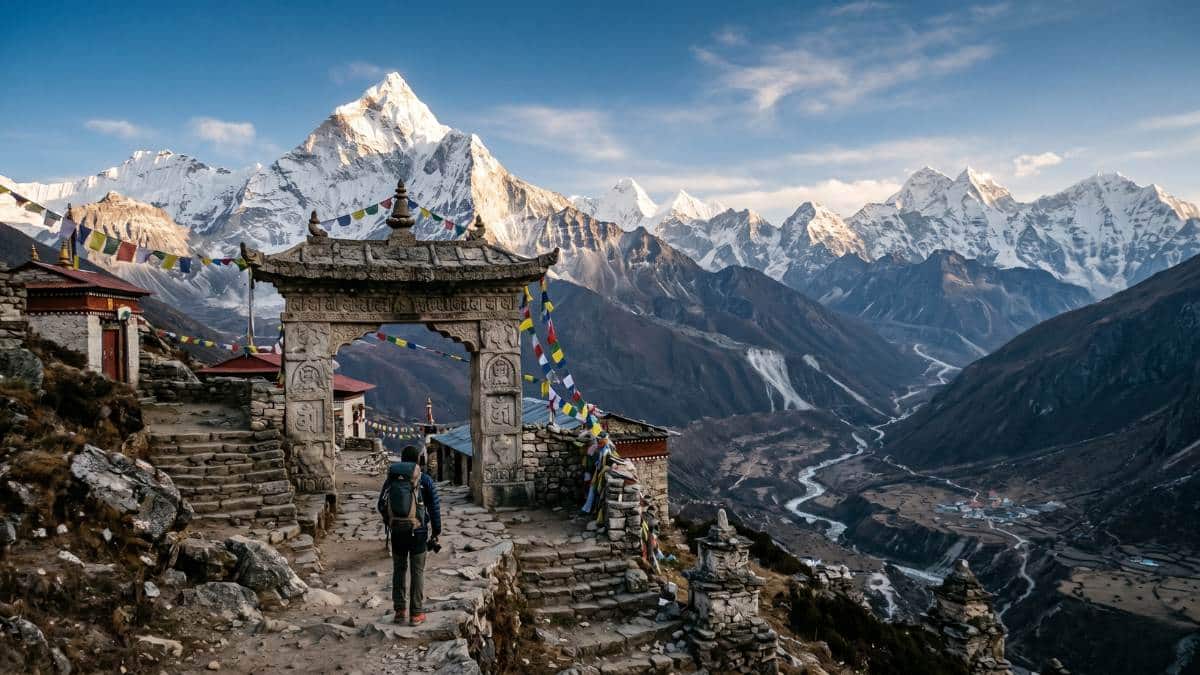
The 2026 Himalayan Summer Survival Kit: A Practical Gateway to the Sacred Trails

Disclosure: Some links in this article are affiliate links. If you make a purchase through them, we earn a small commission at no extra cost to you.
The Himalayas in summer are a profound paradox. While the plains of Bharat swelter under a relentless 45°C sun, the high-altitude spine of the north remains a world of ice, thin air, and ancient silence. To enter this landscape—regardless of whether you are trekking the lush valleys of Garhwal or the high deserts of Ladakh—is to pass through a Sacred Gateway.
This journey requires more than just spirit; it requires a calculated, architectural approach to survival. Whether you are facing a monsoon downpour in the south or a sub-zero blizzard in the north, the physical laws of the Himalayas are absolute.
For the 2026 season, the modern trekker adopts the persona of the Spiritual Architect: one who understands that their gear is a modular life-support system. This is not just a list for a specific trail; this is the Definitive Universal Strategy for any soul seeking resilience in the high Himalayas.
The Unified Blueprint for Himalayan Resilience
The following six pillars form the foundation of your survival architecture. These are not suggestions; they are the non-negotiable requirements for anyone stepping above the tree line. Whether you are on a weekend trek in the foothills or a month-long expedition across the Great Himalayan Trail, these products and strategies are what separate a successful pilgrimage from a physical ordeal.

1. The Strategy: Site Selection & The Temporal Gateway
Before you pack a single carabiner, you must understand the geography of survival. While the fundamentals of high-altitude resilience are a Global Standard—required from the Annapurna Circuit to the peaks of Hemis—your choice of “site” determines the nature of your struggle.
- The High-Altitude Universal: This survival kit is engineered for the entire Himalayan range. The requirements for insulation, hydration, and structural stability do not change, regardless of the trail.
- The Monsoon Choice: If you seek to avoid the heavy rains of the lower ranges (Himachal, Uttarakhand, or Central Nepal) from June to August, you move into the Monsoon Shadow (Ladakh, Spiti, or Upper Mustang).
The Temporal Gateway: When to Cross the Threshold
As a Spiritual Architect, you must align your journey with the mountain’s calendar. While the kit below is your constant, the season dictates your focus:
- Spring (Mar–May): Nepal (EBC/ABC), Uttarakhand, Sikkim. Rhododendrons and rebirth. Focus on moisture management as snow melts.
- Summer (Jun–Aug): The Monsoon Shadow sanctuary (Ladakh/Spiti/Upper Mustang). Focus on UV protection and hydration.
- Autumn (Sep–Nov): All Regions.The Crown Jewel. Crystal clarity and stable weather, but high trail density.
- Winter (Dec–Feb): Lower-altitude treks, Chadar (Ladakh). Primal silence;snow-locked passes and absolute solitude.. Survival is the primary focus; insulation must be at its peak.
2. The 10 Essentials: Life-Support Architecture
In the high Himalayas, these ten items are not just “gear”—they are the pillars of your life-support system. We have expanded these into technical blueprints for the 2026 trekker.

I. Navigation (Digital & Analog)
In an age of GPS, the “Wise Man” still carries a physical topographic map. In 2026, we recommend a hybrid approach. Use MAPS.ME for offline digital tracking, but always keep a laminated map of the Zanskar or Annapurna circuits. Batteries fail in sub-zero temperatures; paper does not.
II. Sun Protection (The Invisible Burn)
At 5,000 meters, the atmosphere is thin, and UV radiation is a physical weight. You require Category 4 Glacier Glasses with side shields to prevent snow blindness. Combine this with SPF 50+ zinc-based sunblock—standard lotions will sweat off during the ascent.
III. Insulation (The Modular Skin)
Because the mountain environment demands a system that adapts at the speed of shifting weather, your clothing must be engineered as a responsive second skin. Below, you will find our definitive options for selecting the three pillars of your insulation: the moisture-wicking base, the high-altitude thermal engine, and the protective elemental shield.

From Valley Heat to Summit Cold: The Modular Layering Guide for the Himalayas
Deep Dive: For a comprehensive masterclass on fabric science and 2026 technical specs, Read the Full 2026 Layering Guide here.
IV. Illumination (Lumens & Lithium)
A headlamp is mandatory. For 2026, prioritize lamps with at least 400 lumens and a red-light mode (to preserve peripheral vision and respect the silence of the campsite). Always use Lithium batteries; they perform 3x better in the Himalayan cold than Alkaline.
V. First Aid (The AMS Protocol)
Acute Mountain Sickness (AMS) is the primary gatekeeper of the Himalayas. Your kit must include Acetazolamide (Diamox), but remember: the only “cure” for AMS is descent. Include O.R.S. (Oral Rehydration Salts) to combat the rapid dehydration caused by high-altitude respiration.
VI. Fire (The Metabolic Spark)
Always carry two ignition sources: a storm-proof lighter and a ferrocerium rod. In the summer monsoon shadow, dry wood is rare. Your fire is your emergency warmth and your method for purifying water.
VII. Repair Kit (Surgical Interventions)
A multi-tool with pliers, ten feet of Paracord 550, and a roll of heavy-duty duct tape. These allow you to repair a snapped rucksack frame or a torn tent fly-sheet in the field, preventing a minor gear failure from becoming a survival situation.
VIII. Nutrition (Caloric Density)
You will burn 4,000+ calories a day. Forget heavy “road trip” snacks. Focus on caloric density: nuts, ghee-based sweets, and energy bars. Your food is the fuel for your internal furnace; if you don’t eat, you won’t stay warm at night.
IX. Hydration (Glacial Purity)
Glacial water is often filled with “rock flour” (silt) that can irritate the gut. Use a 0.1-micron water filter or Katadyn tablets. The Wise Man drinks 4-5 liters a day to keep the blood thin enough to transport oxygen efficiently.
X. Emergency Shelter (The Final Perimeter)
Even if you plan to sleep in teahouses, a Space Blanket or an Ultralight Bivy is non-negotiable. If you are caught in a white-out or a “Monsoon surge” between camps, this 200-gram item is what keeps you alive until dawn.
3. The Sacred Interface: 2026 Footwear Deep-Dive
Your boots are the primary interface between your spirit and the mountain’s ancient geometry. In the Himalayas, standard sneakers are a liability. You need an architectural foundation that protects the ankle and provides unyielding traction.


Why these matter: The Salomon Quest 4 GTX utilizes an active chassis that stabilizes the foot on uneven scree, reducing the mental energy you spend on every step. This “Energy Quotient” (EQ) is vital for long-duration treks.
4. The Carry System: Your Support Pillar
You cannot achieve spiritual equilibrium if your rucksack is digging into your trapezius. A 45L to 65L internal frame rucksack is the “Spine” of your expedition.
- The Logic: A larger pack (65L) used at 80% capacity is significantly more stable than a small pack (45L) overflowing and improperly balanced.
- The Pick: Osprey Atmos AG LT 65 or the Deuter Aircontact Core.

45L to 65L: Finding Your Perfect Himalayan Rucksack (2026 Buyer’s Guide)
Deep Dive:The Definitive 2026 Himalayan Rucksack Guide.
5. Wise Man’s Logistics: The Amazon India Hack
We recommend ordering your BharatDesha Select boots and layers at least 5 days before you arrive from Amazon India. But do check for the prices as they might be more than your local prices as some items will be imported to India. Have them delivered directly to your gateway hotel in Delhi, Manali, or Leh. This ensures you aren’t scrambling in local markets for “knock-off” gear that might fail at 4,000 meters.
6. The Spiritual Pivot: From Survival to Stillness
While technical gear protects your physical frame, a Spiritual Pivot protects your internal focus. For those seeking to bridge the gap between effort and grace, we recommend a curated entry through these sanctuaries. Whether you choose the yogic mastery of Rishikesh or the meditative silence of the Nepal valleys, these retreats provide the ‘internal architecture’ required to truly hear what the mountains are whispering.
The Rishikesh Sanctuary: Yoga & Alignment
The Nepal Sanctuary: Himalayan Meditation
Frequently Asked Questions: The 2026 Himalayan Expedition
Conclusion: Engineering Your Equilibrium
Mastering the Himalayas in 2026 is an exercise in Architectural Preparation. When you treat your gear as a modular extension of your own body, the friction of the “unknown” evaporates, leaving only the purity of the experience.
This Himalayan Summer Survival Kit is your foundation. By investing in the Sacred Footsteps (your footwear), mastering the 10 Essentials, and utilizing the Passport Hack to simplify your logistics, you aren’t just preparing for a trek—you are engineering your own resilience.
Whether you are navigating the high deserts of the Monsoon Shadow or the verdant valleys of the south, the mountains are waiting to reveal their secrets. Your preparation ensures you are finally quiet enough to listen.
Editor’s Note
This guide serves as the primary pillar of our 2026 Himalayan Summer Survival Kit series. At BharatDesha, we believe that technical gear is never about luxury; it is about removing the physical obstacles between your spirit and the sacred.
I have walked these trails when my boots were soaked through and my rucksack was a structural burden rather than a support. The day I shifted from a collection of “stuff” to a Technical System was the day I stopped “surviving” the Himalayas and started truly experiencing them.
My goal with this series—and our specialized guides on Himalayan Layering and Perfect Rucksacks—is to help you find that same transition from effort to grace. I hope this kit provides the structural clarity you need for your own pilgrimage.
Himalayan Summer Survival Kit Series
- 45L to 65L: Finding Your Perfect Himalayan Rucksack (2026 Buyer’s Guide)
- The Modular Layering(Clothing) Guide for the Himalayas


